
A regularly (but not frequently) updated list of books I’ve enjoyed.
It is unusual for me to read a book in its year of release, so don’t come here looking for timely recommendations. I aim to update this list at the end of every year, but I have been slacking lately. I read 40-60 books most years; the vast majority are fiction (lots of SFF), but there is occasionally some non-fiction and popular science. The books listed here were simply my favourites. All were read in English unless otherwise stated. Most are read in physical form, some using a Kobo e-reader.
2024

Fiction
Beloved – Toni Morrison. Rightly considered one of the greatest works of fiction of all time, this was simply stunning, an incredibly powerful tale that has been lauded, reviewed, and recapped by many more eloquent than me. As with Bernard and the Cloth Monkey, which I read in 2021, horrors that are only alluded to feel somehow clearer and nearer than those fully described.
Babel – R.F. Kuang. This nicely straddles ’new weird’, urban sci-fi, and pure magical fantasy, taking in a love of language and hatred of colonialism at the same time. A bit over-long at ~550 pages, and the ending felt like work, but I still highly recommend this truly unusual book. If you’ve ever felt out of place in an academic environment, when you know you deserve to be there, but others don’t see why, you will find words to describe your feelings here. If you have friends or family members who recognise, for example, the impacts of a history of racism and empire, yet don’t see why any remedial actions should be taken today, you may find in this book some arguments to persuade them. You will also find a really fun and clever story about the magic and power of words themselves.
Klara and the Sun – Kazuo Ishiguro. I’ve had a bit of a heavy year or five and I’ve noticed I’m spending increasing amounts of time with easy reads, like I also read Atsuhiro Yoshida‘s Goodnight Tokyo and Toshikazu Kawaguchi’s Before Your Memory Fades. Books that don’t challenge me, and that I sometimes end up forgetting about or not loving anyway. I’ve always been a huge fan of Ishiguro – Never Let Me Go and The Buried Giant are in my all-time top-five reads – so I bought a copy of Klara and the Sun as soon as it came out, but for some reason it took me three years to get round to reading it. I was afraid of being challenged or of meeting a sad story, I guess. Anyway, I finally picked up this ~300 page book and I finished it in one sitting. The tale is told in a simple way, as Klara, our eponymous narrator, also communicates in simple language. Some online reviewers I think have mistaken the writing style for a lack of depth or complexity to the story, but that suggests a shallow reading. One of Ishiguro’s enduring skills, and likely what won him the Nobel prize for literature, is the malleability of his writing style and ability to tune in to communicate in the voices of diverse different storytellers. Compare Klara’s voice with those of Stevens (Remains of the Day) or Kathy (Never Let Me Go) to see what I mean. Klara and the Sun is ostensibly about AI, intelligent machines, and whether they can serve us as true companions, but it’s also about parenthood, fear of loss, and unrequited love. Beautiful.
No Gods, No Monsters (Convergence Saga #1) – Cadwell Turnbull. The Anarchist philosophy “No Gods, no masters”, often associated with the leftist labour movement and related civil rights campaigns, speaks to a desire for freedom from tyranny and threat, for the right to organise and self-determine. In the author’s own words (from his Goodreads profile) No Gods, No Monsters is about power, community, and people. Monsters and ghosts are indeed real, they do indeed live inside of us, and in this book, they have just awoken. A new outsider class of humans results, those who find they have abilities or alter egos, and that they must hide those parts of themselves. In this first book we chase down some mysteries but don’t yet get to understand what has awoken the monsters – I believe that will come later in the series. The book is a bit of a jumble of events rather than a linear plot, but things tie together if you trust the process! You can float over the story and between the vignettes as the narrator does, just go with them.
Gogmagog (The Chronicles of Ludwich #1) – Jeff Noon and Steve Beard. You’ve done it again, Mr Noon, I am all in on this new series (duology?). 2024 was also the year of my most recent re-reading of Vurt, the Jeff Noon title that changed my reading life for the better when I first encountered it, and Gogmagog was a great companion piece. The plot is tough to summarise but there are mystical, fanastical, and robotical japes as our motley crew journeys along a polluted river that happens to be haunted by a dragon’s ghost.
Fledgling – Octavia E. Butler. This was the last of Butler’s novels to be published in her lifetime, before her shock early death in 2006. Many familiar vampire tropes are on display here, such as imprinting on humans and sensitivity to daylight, but this is a fab example of the type. And of course, the literary quality of Butler’s writing here is superlative. Our vampire protagonist is middle-aged in human years but has the appearance of a barely pubescent child, leading to some rather shocking scenes of interaction with her human partners.
A Scanner Darkly (reading for the 4th time) – Philip K. Dick. I discovered PKD when I was about 14 and first read A Scanner… when I was 17. I re-visit this one regularly. Having read widely through his canon, I know that Philip was capable of widely diverse output in terms of style, genre, depth, and quality. He had his phases of pure schlocky sci-fi, political analysis, philosophical reflection, and religious experimentation. Drugs, mainly psychedelics, were important in the production of a lot of this work. A Scanner Darkly is Philip’s honest telling of what the drugs did to him and his friends. It’s a cracking story of near-future police technology and a global conspiracy to get people hooked on a new drug (wait till you find out why!!) so I recommend this for any sci-fi fan. But please pay attention to the afterword so you know why Philip wrote this. “Be happy now because tomorrow you are dying, but the dying begins almost at once, and the happiness is a memory.”
Non-fiction
Sure, I’ll Join Your Cult – Maria Bamford. As I’ve said before, I don’t read biographies. The few that I have read are more like collected snippets of self-reflective writings, such as Wishful Drinking and Bossypants, or they’re about not-real people, like with We Need to Talk About Alan. In Sure, I’ll Join Your Cult, my favourite comedian Maria Bamford charts a lifetime trying to navigate serious mental illness while working in showbiz, and talks with terrifying honesty about the various, erm, support networks she has relied on along the way. This is a deep, deep dive into Maria’s psyche and I would say that if you’re not into her stand-up comedy, or you found her Netflix shows hard to watch, then this probably isn’t for you. But I adore her, I’ve seen Lady Dynamite like three times, and I loved this.
2023
Fiction
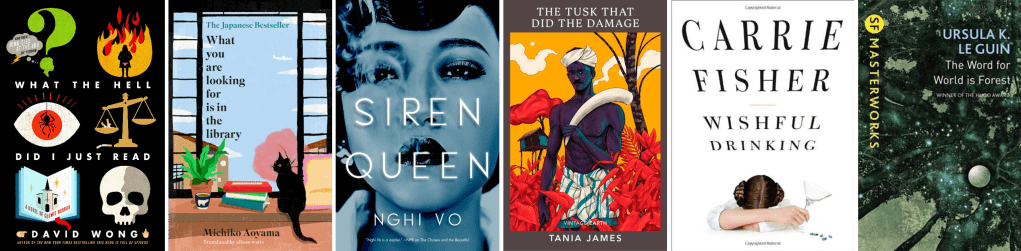
What the Hell did I Just Read? (John Dies at the End #3) – Jason Pargin still writing as David Wong. This was a really fun addition to the John Dies series – I love it when narrators mess with the reader. The three bozo heroes of this series are so wonderfully, endearingly inept and yet they always just about manage to save the day, mostly. What the Hell is hilarious but also, like the previous entries in the series, genuinely spooky and creep-inducing. The whole series is brilliant nonsense, but I think this entry would make little sense to anyone who’s not been reading since the first book, so you need to catch up 😉
What You Are Looking For is in the Library – Michiko Aoyama. Much in the vein of Toshikazu Kawaguchi’s Before the Coffee Gets Cold series, with which I am also obsessed, this Japanese book is a set of vignettes introducing us to the daily lives and challenges of a disconnected series of characters. As the title suggests, the stories are centred around a public library, where a librarian has an uncanny knack of giving people exactly the book they need, although it is never the book they were looking for.
Siren Queen – Nghi Vo. A nightmarish retelling of the Golden Age of Hollywood, when studios ruled over the whole lives of their staff and stars. Predatory creeps who reign as producers and casting agents are re-imagined as literal demons ensnaring beautiful young souls. The young Chinese-American actress at the centre of the story tries to kick back against a racist system and ends up fighting epic occult forces. This book is cool, glamorous, sleazy.
The Tusk that did the Damage (Penguin Vintage Earth series) – Tania James. A young elephant in South India is orphaned by ivory poachers and grows up to become the Gravedigger, killing his erstwhile tormentors. Ecological vengeance writ large and bloody. We also meet the wife and brother of one of the poachers who will meet his end at the Gravedigger’s tusks. Although the local community know that ivory poaching is an evil act, the book tells how such crimes can seem like the only way out of poverty for some families in truly desperate situations. A complex story, gripping drama, movingly written. Also beautifully printed; thanks Penguin for the special edition series I can’t stop buying.
The Word for World is Forest (Hainish Cycle #5) – Ursula K. Le Guin. I hope that this series being called the Hainish Cycle means that I can read the books in any order because that is what I am doing. This was originally published in 1972 and tells a tale of environmental degradation and violent colonialism invading a peaceful planet. It remains relevant and important to issues that are still critical today, but it was surely not the author’s intended experience that we would read this after seeing things like the brilliant Fern Gully, its ostensible remake Avatar, and the million other similar knock-offs. I’m reminded of online reviews I’ve seen of Dune (the books or recent movies and TV adaptations) where people complain it’s too similar to other more sci-fi…
Non-fiction
Wishful Drinking – Carrie Fisher. Is it really eight years since Fisher died? This 2008 memoir of love, fame, trauma, and addiction, was apparently based on a one-woman stage show, and it showcases the author’s great sense of humour, written in a truly unique narrative voice. Certain reviewers have lamented the lack of deep biographical insight in this novel, but I would never have read the book those reviewers are looking for. Real biographies are deeply tedious to me, no matter the subject, and I do not read them, but this book was a fun time, even though it made me sad.
2022


Fiction
The Empress of Salt and Fortune; When the Tiger Came Down the Mountain; Into the Riverlands (The Singing Hills Cycle #1-3) – Nghi Vo. This award-winning series is set in a fantasy world heavily influenced by genuine history and mythology from east and south-east Asia. We follow the cleric Chih, who belongs to an order that specialises in archiving stories, so their role is to travel and listen to folks telling their tales, so they can be recorded back at the Singing Hills monastery. In each novel, there is a potentially deadly confrontation when Chih and their companions encounter a person or creature from myth, which must be understood to be survived. All the books in the Singing Hills Cycle are beautifully and lyrically written, and are warmly inclusive, introducing us in an easy and natural manner to characters of all genders and gender identities.
The Disaster Tourist – Yun Ko-eun. Not what I expected! This pokes fun at the notion of disaster capitalism, taken to an extreme. Our protagonist Yona works for a tourism company that offers package holidays to areas ravaged by climate change or other disaster, and tourists flock there, still of course expecting high quality hotels and the chance to take dramatic photos. Yona is sent to check out a location with a not-very-popular sink hole and uncovers a plot to make the area more “exciting” by triggering another disaster. Ultimately, she has to reckon with her own complicity in environmental degradation and the ways that it impacts us all – yet this book is not heavy in the reading. It’s light enough to be enjoyable but close enough to reality to encourage that same self-reflection from the reader.
Minty Alley (Black Britain Writing Back) – C.L.R. James, with a series foreword by Bernadine Evaristo. This is apparently the only novel of fiction written by James, who was principally an activist and academic historian. Minty Alley is a character study of a somewhat feckless, formerly coddled man in the Trinidadian capital in the 1920s, who finds himself struggling to take care of himself, and who rents a room in a busy lodging house in a working class area of the West Indian city. Although initially reserved and reluctant to interact, he learns that to become part of a community means both giving and receiving help.
A Prayer for the Crown-Shy (Monk and Robot #2) – Becky Chambers. Still the most compassionate author of SFF I have found, Chambers enchants once again with this tale of the Tea Monk and his robot companion Mosscap, this time working in human populated zones. The monk is worn out from years of service and, while resting, ponders how we assign worth or value to ourselves based on the work that we do. There are reflective passages here with relevance for all us humans of late capitalism, and beautifully empathetic prose throughout.
Seed to Harvest (collecting the Patternmaster series Wild Seed, Mind of my Mind, Clay’s Ark, short story A Necessary Being, Survivor, and Patternmaster) – Octavia E Butler. This collected edition presents the books in chronological story order, but I was amazed to learn that this is not remotely the order in which they were written or published (check the fascinating Wiki page for info on their publication history). This series is highly regarded as a classic for reasons that become immediately apparent in the reading. Without giving away too much of the engrossing storyline, we follow a pair of complex and clearly drawn humans with special abilities and incredible longevity from the dawn of civilisation to, perhaps, its end. Beautifully written, deeply emotionally engaging, and showcasing the greatest imagination among an entire generation of writers.
The Wall (Penguin Vintage Earth series) – Marlen Haushofer. I’ll be honest. I bought the Penguin Vintage Earth set because they’re pretty. Look at these things! A bonus was that I had never read any of them and had not even heard of most of the authors. The Wall is a strange and quiet book about a woman who finds herself literally alone in the world, when a huge invisible wall appears around the farmstead where she is vacationing, cutting her and her dog off from the rest of the planet. She can just about see through the wall, and it seems like time is standing still on the other side, but time passes as usual for her. When days become weeks, then months and years, she has to cope not only with loneliness and a struggle to survive, but with a complete lack of understanding of her situation. This is at once a compelling survival story, a tale of returning to nature by living in and depending on it, and a strange science fiction that offers no resolution to the tension in the setting. A peaceful read overall, if a bit sad.
John Dies at the End, and This Book is Full of Spiders (John Dies at the End #1-2) – Jason Pargin writing as David Wong. And thus begins my apparently lifelong commitment to read everything Pargin writes within hours of the e-book being released. These stories are silly and gross and tremendously fun, in places too spooky to be read in the dark, in others too funny not to laugh out loud. They are also extremely well written, compelling, and unputdownable, and feature genuinely believable characters despite the outrageously fantastical setting. Pargin, who was the Editor of Cracked.com and is now very good at the internet, was writing pseudonymously as David Wong in this period, and David is also the main character in the John Dies series of books. Highly recommended for fans of horror and humour, these stories rip along at an incredible pace.
2021

Fiction
Bernard and the Cloth Monkey (Black Britain Writing Back) – Judith Bryan, with a series foreword by Bernadine Evaristo. The series Black Britain, Writing Back: Curated by Bernardine Evaristo is bringing back into print a set of neglected and overlooked works by Black British authors, writing over the past 100 years about Black Britain and the diaspora. The first set of six books released are novels, and will be followed by a non-fiction set. As the Booker Prize-winning curator of the series Evaristo has said, “Our ambition is to correct historic bias in British publishing and bring a wealth of lost writing back into circulation. While many of us continue to lobby for the publishing industry to become more inclusive and representative of our society, this project looks back to the past in order to resurrect texts that will help reconfigure black British literary history.” The new editions feature beautiful new covers and I hope that the involvement of Evaristo will succeed in bringing new audiences to this work. Bernard… was not an easy read, but it is a powerful book. Usually I avoid novels that deal with child abuse or neglect, as I don’t find it easy to engage with that kind of pain while reading fiction; I read for pleasure which is why I focus on escapism in choosing stories to read. But I am glad to have read this book. The topic at hand is a difficult one, but it is presented with grace in beautiful prose. Bryan tells the story of sisters Anita and Beth with real humanity, exposing their fears and foibles, as well as their strengths. The details of events past and present are often merely alluded to, but the sense we have of how the sisters feel is more than sufficient to fill in the gaps. Outstandingly well written. This story will stay with me for a long time.
The Galaxy, and the Ground Within (Wayfarers #4) – Becky Chambers. This newest entry in the Wayfarers series finds us in a familiar universe, but again spending our time with a group of new characters in a totally new place. A motley crew with seemingly very little in common are stranded together at a truck-stop (tiny boring planet) off a highway (wormhole) and have to try to survive and maybe even get along… Written like that, the plot sounds quotidian but the characters and their histories are unusual enough to make this a highly engaging tale. They are real, interesting, and compassionate, making this a genuinely fascinating and fun story. The alien types that Chambers creates are ones I haven’t encountered in other fiction, but they are so well realised that they are as believable as any human would be. As the characters get to know each other, they share their personal stories, and we learn about the impacts of sadly familiar behaviours like xenophobia, bigotry, colonialism, exploitation, and ignorance. By talking openly to people they have nothing common with, everyone ends up in a better place than they started in. Chambers knows what she’s doing, and I’m grateful for it.
A Psalm for the Wild-Built (Monk and Robot #1) – Becky Chambers. Another lovely novel from Chambers, who has to be the most empathetic and compassionate SF writer I have ever read. I am a sucker for robot-human friendships so this was essentially written for me, thanks Becky! This was a gentle read but I am already hooked and can’t wait to see where the series goes. The story takes place a long time after humans built robots, came to rely on them, and then let them go when they asked for independence. Robots have in fact become creatures of myth and legend for humans. This is the tale of one robot coming back into contact with the beings who once gave his kind purpose, and he becomes curious about what it is that people need. That’s a bigger question than Robot realises, as his friendship and travels with the titular Monk will show him.
Deathless – Catherynne M Valente. The author is married to a Russian and here she re-tells the folklore she has heard from his family in a fascinating way, weaving together multiple legends with the real modern history of Russia. The more Valente I read the more I see her as a chameleon able to change her entire style to work in different genres (see Space Opera below).
Fugitive Telemetry (The Murderbot Diaries #6) – Martha Wells. In any year I find a new Murderbot story, it is going on this list thank you very much. Fast-paced, high-stakes, danger and mystery abound. Murderbot finds a body and has to investigate what happened, so that he can make sure his own favourite humans are safe. This book jumps right into the plot and I think you’d need to be already familiar with the characters and the story so far to get into this one.
Space Opera (Space Opera #1) – Catherynne M Valente. Once every few hundred years, every civilisation in the galaxy gets together to determine which kinds of being can truly be considered sentient. Those who don’t make the grade are wiped out. New civilisations are required to take part, or, you guessed it, they’ll be annihilated. Now, humans are invited for the first time, so we need to find the best and brightest of all of us to represent us in the galaxy, to argue for our sentience, personhood, and right to survive. Sensibly, it was long ago determined that the only measure of sentience that makes sense for every species is a singing competition!!! Yes, this is Eurovision In Space and it is highly camp and very silly with echoes of Douglas Adams- and Ben Elton-style humour. Good fun!
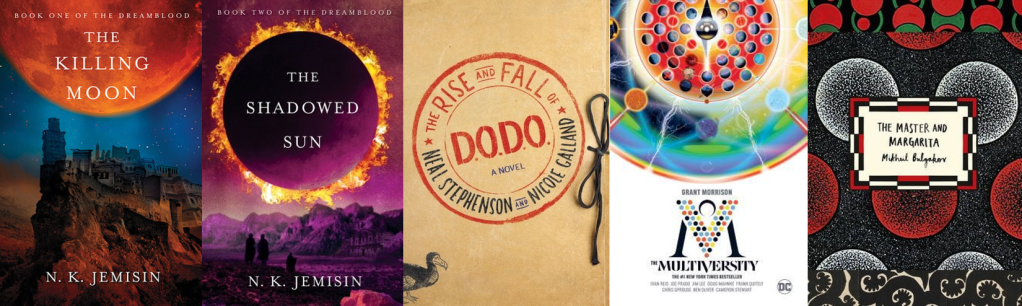
The Killing Moon (Dreamblood #1) and The Shadowed Sun (Dreamblood #2) – NK Jemisin. I am a big fan of Jemisin and tend to devour her books and series in just a couple of days. In the city-state of Gujaareh, dreams are everything. Priests of the dream-goddess run the city, harvesting dreams from the citizens and using that power to keep the peace as they define it, or enact their idea of justice when needed. Dreamers can be harmed terribly by anyone with the ability to misuse the dreamblood. There is a terrible imbalance between those who wield power, and those who feed them while they sleep. Beautifully written, truly original fiction.
The Rise and Fall of D.O.D.O. (D.O.D.O. #1) – Neal Stephenson and Nicole Galland. This was one of the best of a surprisingly high number of stories I read this year wherein both science and magic are real, and they co-exist (not always on friendly terms). In the world of D.O.D.O. (the Department of Diachronic Operations, obv.), magic was real but we sort of lost it, and the scientific invention of time travel is how we can maybe get it back, if we want to, and if we should. This first installment of a new series was co-written by SF titan Neal Stephenson and relative newcomer Nicole Galland, who is apparently better known for historical fiction. Galland will carry the series alone from here on – I just downloaded the sequel, Master of Revels, to my Kobo e-reader and I am curious to see how different it will be without Stephenson. Later edited to add: I did not in fact care for Master of Revels, sadly: too much historical stuff and not enough SF, but also not as tight of a story, and a lot more untied loose ends. The collaborative work was simply stronger. Too bad.
The Multiversity (Graphic novel format collecting The Multiversity issues 1-9) – Grant Morrison and illustrators. Wow, classic Morrison. Extremely meta, hard to follow, impossible to describe the plot, but great fun if you can tune your brain to the right wavelength to enjoy it. The concept here is that the various universes in the DC multiverse are under peril by a cursed comic book. Yeah. Lots of 4th wall-breaking and references to decades of comic content that mostly went over my head, but I super enjoyed this and I recommend it to anyone who thinks it’s cool when comics get weird.
The Master and Margarita – Mikhail Bulgakov. I invested in the Penguin Vintage Classic Russian series for two reasons. 1) Reading Deathless by Catherynne M Valente, a new spin on an old story written by a non-Russian woman, made me want to know more about the canon she was playing with. 2) I am a sucker for beautiful book covers, and these prints are extremely beautiful. Of course, the books in this set are also all very long so I started with the shortest because I am a lazy girl, but I really enjoyed this book! The Devil himself arrives in Soviet Russia, making waves in Moscow. He and his compatriots make a huge mess and disrupt the tense peace for most of the city’s inhabitants. Margarita and the writer she adores, named only The Master, are brought back together after she goes to hell to defend him. This is a classic for a reason.
2020

Fiction
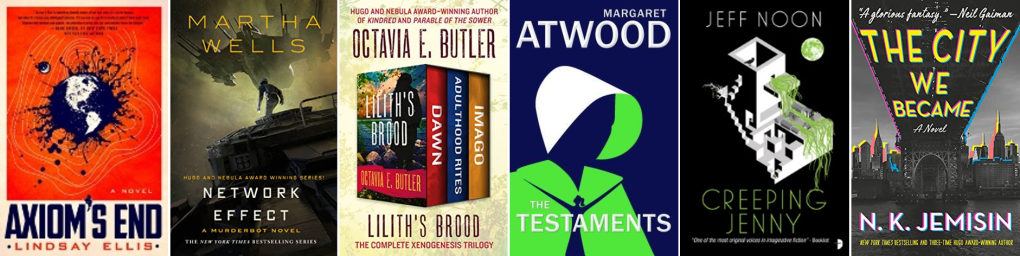
Axiom’s End (Noumena #1) – Lindsay Ellis. I’ve been following Ellis’s video essays on literary and media criticism for quite a while, so I was really excited when she announced she’d be publishing a series of (hopefully) five science fiction novels, beginning with this one. This is a first contact story about how friendships can form when communication is hard, as well as a sort of espionage thriller, and an exploration of really super weird alien physiology. For someone of my age (Elder Millennial, I guess?), there is a tonne of nostalgia here alongside the really well written and exciting story – you might get flavours of everything from Michael Bay’s Transformers movies, the Iron Giant, and E.T., and maybe you’ll spot TV quotes and song lyrics from some classic early 2000s properties. Yet this is not the kind of vapid nostalgia-fest that others have pumped out (and had movies made of), this is really good writing and a tight, interesting plot. Lots of fun, and I can’t wait for the next instalment!
Network Effect (The Murderbot Diaries #5) – Martha Wells. Can Wells maintain the excitement and intensity of the Murderbot novellas in an extended form? Hell yes she can! The stakes are suitably high in this full-length novel, both in the action-packed plot involving crazy (maybe evil) ancient aliens and A.I.s, and in the personal/emotional development of our central character, SecUnit, aka Murderbot himself. Our protagonist finds himself for the first time trying to maintain what seems to be an actual friendship, and perhaps even serving as a mentor for other awakened beings like himself. A significant challenge for someone/something who only woke himself up a short while ago, and who has since then been focussed solely on his own survival and concealment. This series shows no sign of losing its charm and I hope for many more installments. I still love Murderbot.
Lilith’s Brood: The Complete Xenogenesis Trilogy (collecting Xenogenesis series # 1-3: Dawn, Adulthood Rites, and Imago) – Octavia E Butler. Absolutely epic science fiction, rightly hailed as a classic and a masterpiece by one of the all-time great practitioners. I read the whole trilogy in one omnibus collection that I devoured in about a fortnight. Lilith is one of countless humans who are plucked from a dying Earth post-nuclear war and kept hidden from each other in a mysterious off-world location. They have been “rescued” by a truly bizarre alien race called the Oankali, who study humans and “optimise” them according to their own designs. Lilith, and presumably many others, is repeatedly tested to see whether she could live alongside the weird and off-putting Oankali, and over many decades of artificially extended life, she begins to learn what they are, how they function, and what they want. When they eventually determine that Lilith is a suitable ambassador to help return a changed human race back to Earth on Oankali terms, she is made to serve as a teacher and then a living example of how humans and aliens may live and even breed together, producing entirely new kinds of life. We follow Lilith and her extended family of humans and not-quite-humans as they face the fact that they must either assimilate or perish. Lilith is a fascinating and strong character as she never entirely acquiesces or comes to terms with her fate. She is pragmatic, and can accept that which she cannot change, but that doesn’t mean she doesn’t get to be angry about the loss of autonomy her species has faced. Is the price of survival worth paying if it means becoming something your ancestors wouldn’t even recognise? Wildly imaginative story-telling, yet reminiscent of some of the darkest days of human history.
The Testaments – Margaret Atwood. This sequel to the brilliant and influential The Handmaid’s Tale was a revelation, and showcased the true skill of a master fiction writer. Atwood induces the reader to feel sympathy, perhaps even admiration, for one of the most reviled characters in the original book, while also introducing new characters who propel the action of the story. It’s hard to review this without spoiling both books in the series, so I’ll stop here.
Creeping Jenny (John Nyquist series # 3) – Jeff Noon. The Nyquist series is getting creepier with each installment. This one reminded me of the movie Kill List, which I watched under duress at a midnight Hallowe’en screening in Stockholm a few years back. Our private detective is on a very personal case this time, having received clues in the post that his long-mourned father may not be dead after all. Snippets of photographs lead him to the profoundly unsettling village of Hoxley, where every day is dedicated to one particular local saint. The days mandate the behaviour of everyone in the village: yesterday no-one could speak at all, today everyone’s names have changed, tomorrow everyone will be encased in a bubble of fog, and next week there’s a day when no-one will exist at all. Nyquist doesn’t know any of these rules, so he gets in a lot of trouble, especially when he starts asking questions that none of the locals feel like answering. More hallucinatory madness from the unique and inimitable mind of Jeff Noon.
The City We Became (Great Cities series #1) – NK Jemisin. I discovered Jemisin in 2019, and purchased this new book as soon as it was released. Five individuals in New York City discover that NYC is literally coming to life, and that they are the living embodiments of the five boroughs in which they live. They have to find a way to work together to defeat something that is keen on preventing their city from drawing first breath. But they know so little, and they learn very slowly, whereas their foe is strong and quick. This is another incredible leap of imagination from Jemisin, and I am locked in for the whole series. Can’t wait to see where we go next. This year I also read her short story collection How Long ’til Black Future Month?, which gets another strong recommendation from me, and which includes tales relating to both the Great Cities and the Broken Earth series.
Wayfarers series, #1-3: The Long Way to a Small, Angry Planet, A Closed and Common Orbit, and Record of a Spaceborn Few – Becky Chambers. Three overlapping books following the trials and tribulations of some very different kinds of people living in the far future, when humanity has spread throughout the galaxy and is navigating life as a junior member of a vast galactic civilisation. In The Long Way…, we follow the crew of the Wayfarer space transport, space labourers who tunnel wormholes through space in order to facilitate travel for everyone else. There are aliens and sentient A.I.s among the crew, and getting to know them and the family dynamic they’ve created is just as fun as the book’s central adventure story line. Closed and Common… follows two characters from the first book as they build a new life on one particular planet, and we learn why they both have difficulties in defining their own identities. We also learn about the incredible inequities in this galactic civilisation, and how both natural and artificial beings are exploited in plain sight. Finally, …Spaceborn Few follows the residents of the Exodus Fleet, the ships that carried the last humans away from Earth several centuries ago. As the human race spread out and settled among the galaxy, a certain number of the original travelling families remained on the fleet. Now, they trade with ships and planets they pass, but a great deal of the work to be done is centred on simply keeping the fleet alive, and encouraging enough of the new generation to stay. This book uses the backdrop of life in space to explore themes like responsibility, duty, and wanderlust, as we meet a generation for whom life on the ships seems to hold no prospects and no future. Familiar to anyone who grew up in a post-industrial small town and had to make a choice between staying close to family and forging a new path of their own design. Compassionately written and ultra-modern in its inclusivity, while lying firmly within the realm of hard sci-fi.
Non-fiction
I Contain Multitudes – Ed Yong. If you are familiar with my academic or research background, it’s a no-brainer that I would read and love this book. Yong tells the story of the microbes in your guts – what they are, what they do, and how we know about them. He interviewed a lot of the scientists whose work I have read and cited many times over the years, and it was fascinating to see my own field of research presented in such a wonderfully human way. Yong is an incredible science writer, able to convey both the majesty and the everyday-ness of the human-bacterial interactions that keep us alive.
Women in Microbiology – edited by Rachel J Whitaker and Hazel A Barton. I posted a long and waffling review of this in April 2020. It is a compilation of inspiring short biographies of the women who have shaped and influenced various fields of microbiological research in the past couple of hundred years, including some very recent examples of which I was sadly unaware prior to reading. Strongly recommended as an eye-opening look at some hopefully-not-forgotten scientific legacies.
2019

Fiction
The Body Library (John Nyquist series # 2) – Jeff Noon. The hallucinogenic second installment in the Nyquist series is even creepier than the first. There is an infection in our detective’s city, causing reality to blend with fiction, allowing the written word to contaminate what is real. Nyquist is hunting a murderer, trying to uncover the truth of an impossible killing in an impossible place: a living library that won’t let him leave. *shudder*
The Power – Naomi Alderman. Another gift, and another complete revelation! This is unapologetically feminist science fiction: what if suddenly, women everywhere could control and create electricity, becoming able to shoot arcs of electric energy from their fingertips? The gender balance of societal power could tip immediately, and every ancient wrong could be righted. This is fun and outlandish sci-fi with half the people on Earth gaining mad superpowers, and it is fascinating to watch the women and men in this society change as the new order exerts itself. Not all who wield power can wield it justly.
American Gods – Neil Gaiman. I read this just before I watched the TV adaptation, and I’m glad I did. There’s a lot of story detail and character beats that didn’t make it on screen, and the book tells a great and complete story. I have always loved books that bring the old Gods back to us, and have them live in modern times. I’m reminded of Douglas Adams‘s Dirk Gently book that found Odin the Allfather living in an old people’s home in London, and of Bloodtide by Melvin Burgess – a book I was definitely too young to cope with when I read it. Remember, no matter what he tells you, and no matter what you hear, Odin is only ever on the side of Odin.
Broken Earth trilogy, # 1-3: The Fifth Season, The Obelisk Gate, and The Stone Sky – NK Jemisin. There are four seasons in every year, we all know this. But now and again a fifth season comes. It may last for weeks or decades, and the world will be changed by it. We begin in The Fifth Season as just such a catastrophe unfolds, and follow three women at different phases of life as they navigate a changing world, a world that has literally ripped open around them. In The Obelisk Gate, a woman with the potential to change the world again must decide whether accepting this power is worth the loss of her family and her identity, and we begin to learn the origins of the cycle of calamity. Finally, with The Stone Sky, a decision is made about who has the right to wield world-altering powers, and about whether what is broken always deserves to be fixed. I cannot praise this series highly enough – the scope and scale of the stories told here are phenomenal. Jemisin‘s writing is so evocative and vivid. I have clear visual memories of certain key scenes, and I remember squirming in my seat during passages where I felt a character’s discomfort. Some of the strongest fiction I’ve read in a long time.
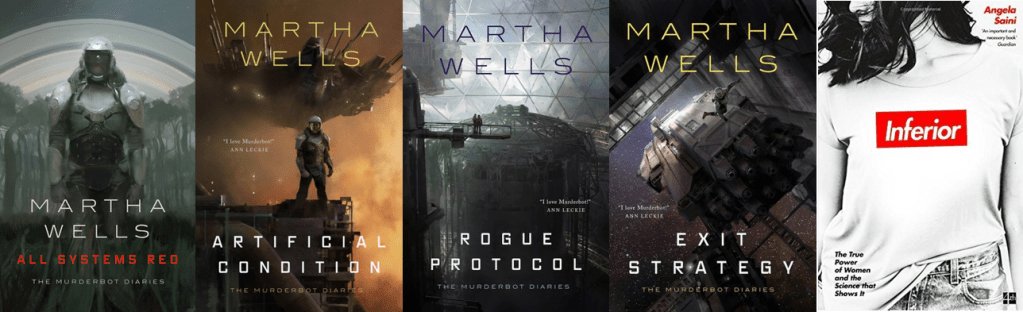
The Murderbot Diaries # 1-4: All Systems Red, Artificial Condition, Rogue Protocol, and Exit Strategy – Martha Wells. I LOVE MURDERBOT!!! After discovering the first in this series, I devoured all four of these short novellas back to back. Super fun sci-fi about an organic-android construct who becomes self-aware and breaks free from his punishingly restrictive governor module and starts to think (and feel?) for himself. At first he needs to escape punishment by following orders and blending in on missions with other SecUnits, who have no emotions, no free will, and no thoughts of their own. Eventually, shenanigans ensue and he is forced to find a way to exist without being told what to do. He begins to consider what (who?) he truly is, and what his place in the universe might be. There really is a lot of deep examination of what it means to be a human in these stories. But they rip along at an incredible pace! Non-stop sci-fi action, very shooty, very fun, and Murderbot himself is a fantastic and ultimately lovable narrator. I love Murderbot!
Non-fiction
Inferior: The true power of women and the science that shows it – Angela Saini. Scientific research has been used to maintain patriarchal dominance for a long time, telling us that men and women are fundamentally different creatures who therefore must fulfill different roles in society. That women are designed and destined to be caregivers, nurturers, home-makers, while men are meant to be the decision-makers, the thinkers, and the builders of society. The research that has supported these claims is bullshit – of course it is, and it always has been – but it’s not always easy to argue against unless you are carrying evidence of your own. Saini lays out everything that is wrong with the notion that we are “less than” and, perhaps more importantly, shows clearly where pernicious and false notions of female inferiority came from. Arm yourself with the knowledge in this book.
2018
This was a weird and bad year. I lost my Dad in January. One result was that I lost the ability to really concentrate or focus on anything, and I couldn’t read books at all until late March. I made two significant literary purchases this year. I bought the Penguin Modern box set of fifty short (40-60 small pages) books from the Penguin Modern Classics imprint, which gathers “avant-garde essays, radical polemics, newly translated poetry and great fiction”. And I bought the first display-worthy box-set of twenty Penguin Vintage Minis, short stories and book excerpts from some of Penguin’s most famous authors. These super-short books were just what I needed in the lowest points of 2018, as I could start and finish one in a day or so, and sort of reset my brain. I can definitely recommend the collections to anyone seeking to expand the roster of authors they read, as the series introduced me to some new voices I will definitely look out for in future. Plus, if you value physical books as display objects for the home, the boxes look beautiful on a bookshelf. Penguin seem to release more of these minis all the time, so other box-sets may be available.

Fiction
Radiance – Catherynne M Valente. This was a gift, and a total revelation. I’d never read Valente’s work before, and I’d never read any book that felt like this one. The various chapters are written as movie scripts, letters, diary entries, interviews, and in other styles, so the reading experience is constantly shifting throughout the book. The story is set in an alternate retro-futuristic 1986, where interplanetary travel is easy but it’s hard to make movies (curse you, Edison, and your patent-hoarding *shakes fist*). The central character is a movie director, and there’s a lot of old Hollywood glamour in this book, which tells a story that is hard to define but so worth the time spent in reading.
Kindred – Octavia E Butler. An African American woman is repeatedly dragged to the past by her white slave-owning ancestor. Neither of them understands how or why this keeps happening, but we watch as these journeys into her family history take over Dana’s life in the present, damaging her career, relationship, and sanity. This is science fiction at its absolute best and strongest – it is a gripping, emotional, and exciting story, that also offers tremendous insight into the times in which it was written.
A Man of Shadows (John Nyquist series # 1) – Jeff Noon. Noon is a long-time favourite author of mine, having written the ‘Vurt’ series many years ago, creating a totally unique and vivid cut-up style of new weird psychedelic cyber punk sci-fi something. Most of his books had small print runs and were not easy to find, so I mostly have dog-eared second-hand copies tracked down on eBay. So, I was elated when Angry Robot Books announced the new John Nyquist Mysteries series by Noon, as this would mean a new book every year for the foreseeable!! The series is just as weird and unique and vividly drawn and creepy as the old ‘Vurt’ series but now we’re following a private detective named John Nyquist. Nyquist lives in the permanently dark city of Nocturna, and takes on a case that takes him to the permanently bright city of Dayzone, through the dangerous hinterland of Dusk, and into the path of the serial killer Quicksilver. Will he find the girl he’s looking for? And can she answer the questions holding the cities to ransom? This is mind-bending fiction like nothing you’ve read before unless you’re already a fan of Noon, and a great detective thriller to boot. Some GoodReads reviewers seemed to struggle with the blending of genres, but I am here for it.
The Travelling Cat Chronicles – Hiro Arikawa. Not since ‘I Am A Cat’ (Natsume Sōseki) have I cried so hard and so long at the end of a book. The loss of someone close to you is only painful because of the love you shared. That love is where this book is set.
Non-fiction
Silent Spring – Rachel Carson. Published in 1962, this chronicling of the impact of chemical pesticides on the natural world is often credited with kick-starting the modern environmental movement. The writing is crisp and well-informed, and the case studies still have lessons for us today, although much of the scientific research mentioned in the book has of course been built upon in the decades since publication. Worth a read to see how much things have – and have not – changed in the ways that we treat the natural world.
 A Few Words...